Now available for mobile phones!

If you wish to view the blog on mobile phone, click here.

Would you like to comment on postings?
Join the Jewish Current Events page on Facebook.

Monday, December 28, 2009

Arabs and Jews Get New Housing Starts in East Jerusalem

From The Israel Project  www.theisraelproject.org   
Contact: Marcus Sheff:  marcuss@theisraelproject.org    


Today (Dec. 28) the Israeli government announced it has approved the construction of 1,192 new housing units for both Arab and Jewish residents of East Jerusalem; 500 housing units have been authorized in the East Jerusalem neighborhood of Silwan for the Arab population, and 692 housing units have been authorized for the mostly Jewish neighborhoods of Har Homa, Neve Yaakov and Pisgat Zeev.[1]

The Israeli government has stated that Israel’s 10-month freeze on settlement construction in the West Bank excludes the East Jerusalem neighborhoods.[2]

Said Jerusalem Mayor Nir Barkat on Nov. 17, "Israeli law does not discriminate between Jews, Muslims, and Christians or between eastern and western Jerusalem. The demand to halt construction by religion is not legal in the United States or in any other free place in the world. I do not presume that any government would demand to freeze construction in the United States based on race, religion or gender and the attempt to demand it from Jerusalem is a double standard and inconceivable."[3]

On Nov. 25, Israeli Prime Minister Benjamin Netanyahu announced the 10-month construction freeze on West Bank settlements - a gesture to the Palestinian Authority to build confidence between the two sides and restart peace negotiations.[4] Despite significant political and public opposition in Israel, the freeze is currently in effect and is being enforced by government agencies and security services.[5]

The majority of the land on which the East Jerusalem neighborhoods of Neve Yaakov and Har Homa are built was purchased by Jewish organizations or individuals before the State of Israel was established in 1948, or was legally acquired by the Israeli government post-1967.
 
In more news, tomorrow (Dec. 29), Netanyahu is scheduled to meet with Egyptian President Hosni Mubarak in Egypt. The meeting between the two leaders will focus on ways to advance the Israeli-Palestinian peace process.[11] 
 --------------------------
The full article is found online at  
http://www.theisraelproject.org/site/apps/nlnet/content2.aspx?c=hsJPK0PIJpH&b=689705&ct=7790991

Sunday, December 27, 2009

Manji rallies Muslim expression against anti-Semitism

(JTA) -- Muslims placed personal messages against anti-Semitism on the Facebook page of a Muslim reformist and author.

The hundreds of personal messages on Irshad Manji's Facebook fan page were a thank you to the European Union of Jewish Students, for their statement earlier in the month condemning the Swiss vote to ban minarets in the country.

Following the Dec. 2 EUJS statement, Manji, the author of  “The Trouble with Islam Today: A Muslim’s Call for Reform in Her Faith” and the producer of the Emmy-nominated film, "Faith Without Fear," asked her Muslim fans to post personal statements against anti-Semitism.

"The move by Irshad Manji and EUJS has shown how successful and meaningful the Jewish and Muslim connection can be on a grassroots level. We hope that this connection is only the beginning of a springboard for further dialogue, cooperation and collaboration between Jewish and Muslim groups," read a statement from EUJS in its December newsletter.
 

IDF kills Fatah terrorists and Gaza infiltrators

Fatah officials in the West Bank demanded on Saturday [December 26, 2009] that the Palestinian Authority put an end to security coordination with Israel, after the IDF killed three Al-Aksa Martyrs Brigades operatives who were behind the Thursday shooting attack that killed [an Israeli, ] Meir Chai.

[Note: According to Ma'an, the Palestinian news service, "On Thursday, the Mughniya faction [of Fatah's Aksa Martyrs Brigade] said its members killed an Israeli settler near Nablus. In an emailed message, the organization also warned of "a series of attacks to come."" ]

Fayyad and commanders of the PA security forces visited the families of the three Fatah gunmen to offer condolences.

Nabil Abu Rudaineh, a spokesman for PA President Mahmoud Abbas, said that the Nablus raid, as well as the killing of three Palestinians from the Gaza Strip who tried to cross the border into Israel, showed that Israel "does not want peace." 

[From report, "PA urged to end cooperation with Israel," by Khaled Abu Toameh,  Dec. 26 and 27, 2009.  The article also notes that the IDF had also intercepted and killed three Palestinians trying to enter Israel from Gaza.]


----------
IDF identifies the Aksa Martyrs Brigade/Fatah terrorists:


Nader/Raed A-Gabar Machmad Surkajy, a 40 year old resident of Nablus, is a Nablus Fatah Tanzim activist and has been imprisoned in Israel in the past. Prior to his arrest in 2002, Surkajy was a senior member of the Al-Aqsa Martyrs Brigades and was involved in multiple terror attacks. Surkajy was also involved with the manufacturing of explosives and the establishment of an explosives-manufacturing laboratory in Nablus. Surkajy was arrested in April 2002 and was released earlier this year in January 2009.

Assan Fatachi Naif Abu Sharach, a 40 year old Nablus resident, has also been previosly imprisoned in Israel. He is the brother of Naif Abu Sharach, the former head of the Fatah Tanzim in Nablus, who was responsible for planning multiple terror attacks until he was killed by IDF soldiers in 2004.

Annan Saliman Mustafa Tzubach, a 36 year old Nablus resident, a Shahad Al-Aqsa activist and was involved in widespread militant activity within the framework of the Nablus Fatah Tanzim. The group was led by Naif Abu Sharach until his death. Annan served as an arms dealer and supplier. During an attempt to arrest him tonight, Annan was killed after an exchange of fire with the IDF while he was found in a hiding place along with weapons and ammunition. Annan was included in an agreement in which wanted terror suspects were granted amnesty in exchange for a cease and desist in all terror involvement.


Friday, December 25, 2009

Egypt "concerned" about Iranian regional ambitions

Want to know what's really happening in the Middle East?  Read the following carefully.  //Mark Finkelstein, jcrc@dmjfed.org

Al-Ahram Weekly 17-23 Dec'09:  ["Little chance of Egyptian] Rapprochement with Iran"     excerpts

Egypt and Iran have not been able to normalise relations, and Iranian regional ambitions may mean that they will not be able to do so, writes Salah Hemeid

During a tour of the Arab Gulf last week, Egyptian Foreign Minister Ahmed Abul-Gheit renewed his country's concern over Iran's mounting influence in the region and reiterated that Egypt will stand by its brethren in the Gulf against any threats to their security.

... [I]n recent months Egypt has repeatedly accused Iran of attempts to expand in areas such as the Gulf, Iraq, Yemen and the Horn of Africa, all considered by Egypt as vital to its national security.

....
Mustafa El-Feki, head of the Egyptian parliament's Foreign Relations Committee, described Iranian-Arab relations in general as "unsound", attributing this to an Iranian "tendency for hegemony" and "Persian national aspirations".

Yet El-Feki rejected an Arab school of thought that equates what it calls the "Iranian threat" to that posed by Israel. "It is true that Iran poses a danger, but this cannot be compared to the danger implanted in the heart of the Arab world," he said, referring to Israel.
....

Many  participants [in the conference]  warned that Iran was increasingly interfering in Arab affairs, and that the Arabs should not restore full ties before Iran dropped its current policy of regional expansion and interference in Arab affairs.
 ....

 To Iran, Egypt's efforts to bring about peace in the region, and its encouragement of the Palestinians and other Arab countries to follow its path with Israel, threaten to deprive Tehran of the single most potent regional issue that it can exploit to further its radical agenda.

Therefore, Iran seeks to undermine prospects for peace, and, along with its clients such as Hamas and Hizbullah, it believes the way to do this is by undermining Egypt.
 ....
The battle for competing regional influence also extends to Iraq and Lebanon, where Iran has been building a power base among the Shias in these two Arab countries.
 ....
  Like many other Arab countries, Egypt is worried about Iran's interference in Lebanon, which Tehran is using to bolster its regional influence.  Similarly, Egypt's security interests in the Gulf, and its traditional role as a force for regional stability, present a clear obstacle to Iran's wider regional ambitions.

Also like other Arab countries, Egypt is concerned that any US rapprochement with Iran could ultimately lead to a nuclear-armed, non- Arab, and Shia superpower expanding its influence further in the region.

Egypt fears that the offer of an improvement in US-Iran ties held out by US President Barack Obama could go too far, offering concessions to a powerful regional player long regarded with suspicion.

JTA: Jewish organizations 'tweeting' their way to new kinds of communications


Scores of Jewish organizations are now using Twitter ( http://twitter.com ) to send their members short, cell phone-based, text messages.   See: http://digg.com/u1IKrc


The Jewish Federation of Greater Des Moines has two Twitter networks to keep community members informed.  One mirrors the JCRC InfoBlog at twitter.com/jewishnewsblog 

A new network that we are still developing is to update information about Federation programming.  It will be especially useful to convey any last minute changes to time/date/location or content of programs.  The network is called Update J and its messages are displayed online at twitter.com/updatej   and on the Federation's website: http://jewishdesmoines.org. 

The easiest way to sign-on to receive Tweets is to send a text message to 40404 and ask to: follow  updatej  or follow jewishnewsblog  (or any other of the many Tweeters)  . Standard text messaging charges apply, as determined by your cellphone company. 

Consult your synagogue or temple for information about the Tweet networks they operate!


On the Internet, there is an extensive listing of Jewish organizations that Tweet.  Below, for example, is just the very beginning of the directory available at http://listorious.com/MASA__Israel/jewish-organizations
 

For additional information, contact jcrc@dmjfed.org

Now, from the listorious.com list of Jewish organizations that Tweet:

MAZON

MAZON is the leading Jewish anti-hunger organization, devoted to ending hunger among all faiths and backgrounds. (Maintained by Ed Robins, Donor Services Dept.)
11,443 followers |

Israeli Consulate

The official twitter for the Consulate General of Israel in New York
7,860 followers |

US Holocaust Museum

The United States Holocaust Memorial Museum is a living memorial, inspiring citizens to confront hatred, promote human dignity and prevent genocide.
7,727 followers |

92YTribeca

Non profit / Art Space / Music Venue / Cafe / Screening Room / Classes / Comedy / More
4,527 followers |

92nd Street Y

The 92nd Street Y is an arts, educational and community center serving people of all ages, races, faiths and backgrounds.
3,832 followers |

United With Israel

Organizing people of all faiths to unite and show their unwavering support for Israel.
3,481 followers |

JTA | Jewish news

The Global News Service of the Jewish People
2,810 followers |

The Jewish Week

The Jewish Week, an independent community newspaper, is recognized widely as the largest and most respected Jewish newspaper in America.
2,759 followers |

Wednesday, December 23, 2009

Jacoby: The 4 reasons why Americans are so pro-Israel

Why are Americans so pro-Israel?

by Jeff Jacoby   MetroWest Jewish Reporter   December 2009


WHY ARE AMERICANS so pro-Israel?

Of all the ways in which the United States marches to the beat of its own drummer, few are more striking than the American people's consistent and deep-rooted support for the Jewish state.

In a recent nationwide survey, the Gallup organization asked Americans: "In the Middle East situation, are your sympathies more with the Israelis or more with the Palestinians?" For the fourth year in a row, 59 percent -- nearly 6 in 10 -- said their sympathies were with Israel, while just 18 percent sided with the Palestinians.

When respondents were asked for their opinion of various countries, 63 percent said they had a favorable view of Israel (21 percent said very favorable), compared with just 15 percent who thought highly of the Palestinian Authority.
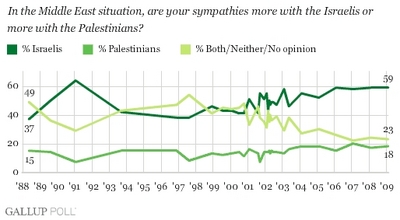
Conversely, only 29 percent of Americans told Gallup that their opinion of Israel was negative, even as a whopping 73 percent expressed a negative attitude toward the Palestinians.

This overwhelmingly positive feeling for Israel is normal for the United States, but it puts Americans sharply at odds with the rest of the world. At the United Nations, for example, nothing is more routine than the castigation of Israel. Similarly, any time Israel is forced to use its military power in self-defense, it comes under the harsh glare of the international media, which subject it to a scrutiny far more unforgiving than any other country receives. It was only a few years ago that a poll commissioned by the European Union found that a plurality of Europeans regarded Israel as the greatest threat to world peace -- more menacing than even North Korea or Iran.

So what makes Americans different?

Foreign policy "realists" could certainly suggest reasons why close friendship with Israel is not in America's interest, beginning with the fact that most of the world doesn't share it. There are 300 million or more Arabs in the world, and they sit atop a vast share of the world's oil supply. Why endanger American access to that oil by maintaining such close ties to a nation with only 6 million people and no petroleum to export? Why risk incurring the wrath of Islamic terrorists by supporting Israel, a nation most of them detest? Surely it would make more sense -- so a "realist" might argue -- for Americans to distance themselves from the world's lone Jewish state, and tilt instead toward the much greater number of nations and governments that are hostile to Israel.

Yet most Americans instinctively reject such advice. The national consensus in support of Israel is longstanding and durable, and it isn't grounded in economics, energy policy, or a quest for diplomatic popularity. Nor, as some conspiracy-minded critics have claimed, is it because a "Zionist lobby" in Washington routinely hijacks US foreign policy, manipulating America into serving Israel's ends.

The roots of America's bond with Israel lie elsewhere.

First, Americans stand with Israel because in it they recognize a liberal democracy much like their own: a nation in which elections are lively, fair, and democratic; in which freedom of speech and the press are core values; in which the political rights of minorities are respected; and in which a commitment to civil liberties and justice is woven into the very fabric of society.

Second, Americans know that Israel is a stable ally in one of the world's most critical and volatile regions. Its intelligence service is perhaps the world's finest, its military is the best in the Middle East, and its painfully acquired expertise in counterterrorism is invaluable -- all the more so as we wage our own war against jihadi terrorists.

Third, Americans sympathize with Israel because they understand that the enemies of Israel hate the United States as well. The suicide bombers who revel in the death of innocent Jews, the fanatics who chant "Death to Israel," the Iranian- and Syrian-backed forces that launch rockets from Gaza or Lebanon with the aim of shedding Israeli blood -- they are steeped in the same murderous ideology as Osama bin Laden and the Islamists who slaughtered so many Americans on Sept. 11, 2001.

And fourth, there is a deep religious bond between American Christians and the Jewish people, a bond that stretches back to the earliest era of American history. More than a century before the Revolutionary War, the Puritan leader Increase Mather taught his followers to anticipate the day when the Jews would return to their homeland and establish "the most glorious nation in the whole world." In 1819, former President John Adams wrote of his wish to see "the Jews again in Judea an independent nation." Today, tens of millions of American evangelicals passionately support -- even love -- the Jewish state, and consider it nothing less than their duty as Christians to stand with Israel and her people.

Why are Americans so pro-Israel? For reasons practical and idealistic, religious and strategic. They are linked by the kinship of common values -- an affinity of strength and decency that reflects the best of both nations, and sets them apart from the other nations of the world.

(Jeff Jacoby is a columnist for The Boston Globe.)

Tuesday, December 22, 2009

Besser: Why Carter still doesn't get it


I was intrigued by Jimmy Carter’s Chanukah message to the Jewish community, delivered via JTA, which provided a real insight into what makes him a decent human being – and made him a wretched failure as a president and Middle East policy analyst, which he fancies himself to be.

I never bought the idea that Carter, author of Palestine: Peace Not Apartheid as well as a Camp David agreement that brought peace between Israel and what was once its most dangerous enemy,  is an anti-Semite or an Israel hater, despite his vehement opposition to many Israeli policies and his dislike of some of the country’s leaders.

I do buy the argument that he somehow expects the world to conform to his deep religious belief in turning the other cheek and loving your enemy, which is fine for a pastor but a disaster for a president who has to deal with a real world where those values are rare – and where those who subscribe to them tend to get victimized by those who don’t.

In his message to JTA, Carter wrote: “I have the hope and a prayer that the State of Israel will flourish as a Jewish state within secure and recognized borders in peaceful co-existence with its neighbors and with all the Moslem States, and that this peaceful co-existence will bring security, prosperity and happiness to the people of Israel and to the people of the Middle East of all faiths.”

Well, yeah? Who can argue with that?

He goes on: “I have the hope and a prayer that the bloodshed and hatred will change to mutual respect and cooperation, fulfilling the prophetic aspiration that the lion shall lie down with the lamb in harmony and peace. I likewise hope that violent attacks against all civilians will end, which will help set a better framework for commencing negotiations. I further hope that peace negotiations can soon commence, with all issues on the negotiating table.”

Great hopes; we all share them, or at least most of us.

The problem is, you can’t create policy out of hope. And lying down with lions doesn’t work when the lions aren’t reading from the same Gospels.

The Chanukah message – in which he asks forgiveness from the Jewish community for “words or deeds of mine” that may have stigmatized Israel  -   makes it clear that Carter still sees the world in absolute black and white terms; for all his experience during his presidency and in the decades since, he hasn’t noticed that there are few real lambs in the world. He also hasn’t figured out that  just because a country is strong – a lion, maybe like Israel –  its adversaries aren’t automatically innocent lambs.

Presidents – and those who seek to influence policy, as Carter has done since he left the White House – have to look at the world as it is, not as they want it to be. Carter looks at the Middle East and just sees lions and lambs, all-powerful occupiers and their innocent victims  – which means he’s never going to get it right.

This blog has raised questions about pro-Israel evangelical Christians who support Israeli hardliners because of a prophetic perspective relating to their view of the Second Coming. Carter brings to the issue a different kind of prophetic message, but one that is no less out of touch with the vastly complex and difficult environment in which Israel has to find its way.

There’s a place for religious moralists who dream of a day when we can all just get along and who reduce agonizingly complex dilemmas into simple lessons. That place isn’t in the White House.

http://jewish-politics-ny.com/2009/12/22/jimmy-carters-message-to-the-jewish-community-lions-lambs-and-why-he-still-doesnt-get-it/