Now available for mobile phones!

If you wish to view the blog on mobile phone, click here.

Would you like to comment on postings?
Join the Jewish Current Events page on Facebook.

Showing posts with label U. S. - Israel relations. Show all posts

Wednesday, December 23, 2009

Jacoby: The 4 reasons why Americans are so pro-Israel

Why are Americans so pro-Israel?

by Jeff Jacoby   MetroWest Jewish Reporter   December 2009


WHY ARE AMERICANS so pro-Israel?

Of all the ways in which the United States marches to the beat of its own drummer, few are more striking than the American people's consistent and deep-rooted support for the Jewish state.

In a recent nationwide survey, the Gallup organization asked Americans: "In the Middle East situation, are your sympathies more with the Israelis or more with the Palestinians?" For the fourth year in a row, 59 percent -- nearly 6 in 10 -- said their sympathies were with Israel, while just 18 percent sided with the Palestinians.

When respondents were asked for their opinion of various countries, 63 percent said they had a favorable view of Israel (21 percent said very favorable), compared with just 15 percent who thought highly of the Palestinian Authority.
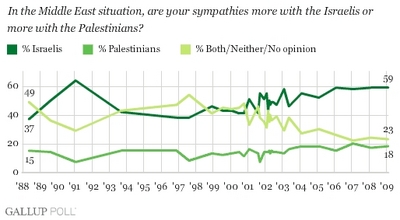
Conversely, only 29 percent of Americans told Gallup that their opinion of Israel was negative, even as a whopping 73 percent expressed a negative attitude toward the Palestinians.

This overwhelmingly positive feeling for Israel is normal for the United States, but it puts Americans sharply at odds with the rest of the world. At the United Nations, for example, nothing is more routine than the castigation of Israel. Similarly, any time Israel is forced to use its military power in self-defense, it comes under the harsh glare of the international media, which subject it to a scrutiny far more unforgiving than any other country receives. It was only a few years ago that a poll commissioned by the European Union found that a plurality of Europeans regarded Israel as the greatest threat to world peace -- more menacing than even North Korea or Iran.

So what makes Americans different?

Foreign policy "realists" could certainly suggest reasons why close friendship with Israel is not in America's interest, beginning with the fact that most of the world doesn't share it. There are 300 million or more Arabs in the world, and they sit atop a vast share of the world's oil supply. Why endanger American access to that oil by maintaining such close ties to a nation with only 6 million people and no petroleum to export? Why risk incurring the wrath of Islamic terrorists by supporting Israel, a nation most of them detest? Surely it would make more sense -- so a "realist" might argue -- for Americans to distance themselves from the world's lone Jewish state, and tilt instead toward the much greater number of nations and governments that are hostile to Israel.

Yet most Americans instinctively reject such advice. The national consensus in support of Israel is longstanding and durable, and it isn't grounded in economics, energy policy, or a quest for diplomatic popularity. Nor, as some conspiracy-minded critics have claimed, is it because a "Zionist lobby" in Washington routinely hijacks US foreign policy, manipulating America into serving Israel's ends.

The roots of America's bond with Israel lie elsewhere.

First, Americans stand with Israel because in it they recognize a liberal democracy much like their own: a nation in which elections are lively, fair, and democratic; in which freedom of speech and the press are core values; in which the political rights of minorities are respected; and in which a commitment to civil liberties and justice is woven into the very fabric of society.

Second, Americans know that Israel is a stable ally in one of the world's most critical and volatile regions. Its intelligence service is perhaps the world's finest, its military is the best in the Middle East, and its painfully acquired expertise in counterterrorism is invaluable -- all the more so as we wage our own war against jihadi terrorists.

Third, Americans sympathize with Israel because they understand that the enemies of Israel hate the United States as well. The suicide bombers who revel in the death of innocent Jews, the fanatics who chant "Death to Israel," the Iranian- and Syrian-backed forces that launch rockets from Gaza or Lebanon with the aim of shedding Israeli blood -- they are steeped in the same murderous ideology as Osama bin Laden and the Islamists who slaughtered so many Americans on Sept. 11, 2001.

And fourth, there is a deep religious bond between American Christians and the Jewish people, a bond that stretches back to the earliest era of American history. More than a century before the Revolutionary War, the Puritan leader Increase Mather taught his followers to anticipate the day when the Jews would return to their homeland and establish "the most glorious nation in the whole world." In 1819, former President John Adams wrote of his wish to see "the Jews again in Judea an independent nation." Today, tens of millions of American evangelicals passionately support -- even love -- the Jewish state, and consider it nothing less than their duty as Christians to stand with Israel and her people.

Why are Americans so pro-Israel? For reasons practical and idealistic, religious and strategic. They are linked by the kinship of common values -- an affinity of strength and decency that reflects the best of both nations, and sets them apart from the other nations of the world.

(Jeff Jacoby is a columnist for The Boston Globe.)

Tuesday, May 19, 2009

Detailed Analysis of Obama-Netanyahu Meeting/Part 2 What Netanyahu Said

By Barry Rubin

Obviously, Prime Minister Benjamin Netanyahu’s job was to make a good impression including the flattery of President Barack Obama. He thus thanked him:

“For your friendship to Israel and your friendship to me. You’re a great leader--a great leader of the United States, a great leader of the world, a great friend of Israel, and someone who is acutely cognizant of our security concerns. And the entire people of Israel appreciate it, and I speak on their behalf.”

But this is more than flattery. Netanyahu is defining him as a great leader in part because he is a great friend of Israel. In other words, he is locking him in on his commitments to what Obama called an “extraordinary relationship.” This is the standard which the American president has set for the relationship and Netanyahu will hold him to it.

He also wants to define common interests: “We share the same goals and we face the same threats.” This happens to be true though it may take some time for Obama to recognize it.

Netanyahu also wants to stake out his own identity as a peacemaker:

“The common goal is peace. Everybody in Israel, as in the United States, wants peace. The common threat we face are terrorist regimes and organizations that seek to undermine the peace and endanger both our peoples.”

But how is peace to be obtained? Who is the common enemy?

A. The Iran issue

“In this context, the worst danger we face is that Iran would develop nuclear military capabilities. Iran openly calls for our destruction, which is unacceptable by any standard. It threatens the moderate Arab regimes in the Middle East. It threatens U.S. interests worldwide. But if Iran were to acquire nuclear weapons, it could give a nuclear umbrella to terrorists, or worse, it could actually give terrorists nuclear weapons. And that would put us all in great peril.”

This is broadening out the threat beyond Israel to encompass U.S. interests and those of moderate Arab regimes, as I have long argued.

So Netanyahu reinforced what he wanted to, without mentioning the engagement part:

“So in that context, I very much appreciate, Mr. President, your firm commitment to ensure that Iran does not develop nuclear military capability, and also your statement that you’re leaving all options on the table.”

B. Israel-Palestinian Negotiations

On this issue, Netanyahu stressed his eagerness to cooperate, his “desire to move the peace process forward.” Indeed, he was ready to move very fast: “And I want to start peace negotiations with the Palestinians immediately. I would like to broaden the circle of peace to include others in the Arab world, if we could….”

Here came Netanyahu’s most quoted lines, which should be quoted fully:

“I want to make it clear that we don’t want to govern the Palestinians. We want to live in peace with them. We want them to govern themselves, absent a handful of powers that could endanger the state of Israel. And for this there has to be a clear goal. The goal has to be an end to conflict. There will have to be compromises by Israelis and Palestinians alike. We’re ready to do our share. We hope the Palestinians will do their share, as well. If we resume negotiations, as we plan to do, then I think that the Palestinians will have to recognize Israel as a Jewish state; will have to also enable Israel to have the means to defend itself. And if those conditions are met, Israel’s security conditions are met, and there’s recognition of Israel’s legitimacy, its permanent legitimacy, then I think we can envision an arrangement where Palestinians and Israelis live side by side in dignity, in security, and in peace.”

Here is Netanyahu’s view of the two-state solution. If the Palestinians meet Israeli conditions, then there will be the “side by side” arrangement Obama has raised.

This is critical: a two-state solution is not something given as a present at the beginning of negotiations, it is a reward for the proper compromises that enable such a peace to succeed.

That is the key point of the Israeli position, regarding not just Netanyahu but in practice across much of the political spectrum.

Netanyahu fully recognizes the interrelationship of issues and says both are important:

“It would help, obviously, unite a broad front against Iran if we had peace between Israel and the Palestinians. And conversely, if Iran went nuclear, it would threaten the progress towards peace and destabilize the entire area, and threaten existing peace agreement.”

And so he concludes, “We see exactly eye to eye on this—that we want to move simultaneously and then parallel on two fronts: the front of peace, and the front of preventing Iran from acquiring nuclear capability.”

Many might view this as papering over differences but it really isn’t. The point Netanyahu makes is that the two countries agree in principle whatever differences there are on details. And after all, this is the same basic position Obama has stated, though there is a bit of reversal on apparent priorities.

And then Netanyahu raises another key Israeli point: It is quite possible to make things far worse:

“If we end up with another Gaza -- the President has described to you there’s rockets falling out of Gaza -- that is something we don’t want to happen, because a terror base next to our cities that doesn’t call -- recognize Israel’s existence and calls for our destruction and asks for our destruction is not arguing peace.

“If, however, the Palestinians recognize Israel as the Jewish state, if they -- if they fight terror, if they educate their children for peace and to a better future, then I think we can come at a substantive solution that allows the two people to live side by side in security and peace and I add prosperity, because I’m a great believer in this.”

What is the point, after all, of pushing through a two-state solution which:

--Makes Palestine a radical Islamist state tied to Iran and Syria.

--Creates a Palestine in which every school, mosque, and media institution teaches Palestinians that all of Israel is theirs and they must strive to conquer it. This would be a Palestine full of incitement to violence against Israelis which will inspire scores of people to become terrorists and thousands of others to support them.

--Sets off a new Israel-Palestine cross-border war, with the Palestine government either looking the other way or actively assisting terrorists.

--Creates a Palestine that invites in Iranian, Syrian, or other armies, or gets missiles from them targeted at Israeli cities.

--Extends the conflict another generation by using the state as a base for a “second stage” to finish off Israel.
And if Israel were to take risks and make concessions will they be reciprocated? And if the United States and Europe makes promises to Israel will they be kept?

After all, the 1990s’ peace process taught Israelis the answer was “no” on both counts.

This is Israel’s central point: peace, yes, but only a real, lasting, and stable situation which makes things better rather than worse.

A two-state solution only if it isn’t a two-mistake anti-solution
--------------
Barry Rubin is director of the Global Research in International Affairs (GLORIA) Center and editor of the Middle East Review of International Affairs (MERIA) Journal. See the GLORIA/MERIA site at www.gloria-center.org.

Monday, May 18, 2009

Transcript of the Obama and Netanyahu press conference

Commentary: Decoding Bibi and Barack

Netanyahu on Iran: Israel has the right to defend itselfPublished: 05.18.09, 23:27 / Israel News

Prime Minister Benjamin Netanyahu said that Israel has the right to defend itself against Iran. Netanyahu's statement was made to Israeli reporters in Washington following the prime minister's meeting with US President Barack Obama. (Yitzhak Benhorin, WASHINGTON)