Now available for mobile phones!

If you wish to view the blog on mobile phone, click here.

Would you like to comment on postings?
Join the Jewish Current Events page on Facebook.

Monday, May 9, 2011

Fatah official: "No one in either Fatah or Hamas recognizes Israel"

[Readers of this blog are encouraged to join http://facebook.com/jewishcurrentevents ]


Senior Palestinian MP: Fatah, Hamas Share Stance on Not Recognizing Israel

TEHRAN (FNA)- A senior Palestinian legislator and member of the Fatah Movement underlined on Monday that Fatah and the Palestinian Islamic Resistance Movement (Hamas) share the same view on the Zionist regime's entity as neither one recognizes the Israeli regime as a state.


"No one in Fatah and Hamas movements recognizes Israel," Abdullah Abdullah told FNA, asked if the so-called Fatah-Israel peace talks would continue, given Hamas's opposition to the process.

The Fatah official further stressed Israel should realize that it cannot rule the peace process while having Palestinian territories under occupation.

"Palestinians who are a nation under occupation have and will resist against the occupiers and we witness Palestinian resistance and conflicts with the Zionist regime in most regions," he said.

The official underlined that Fatah would never attend any negotiation with the Israeli regime if such talks are not based on the international rules, and stated, "If Israel withdraws from the Palestinian and Arab lands, it might be possible to enter peace negotiations."

"If Tel Aviv does not withdraw from the Palestinian territories, all Palestinian groups will resist against this occupation along with the Palestinian people," Abdullah underlined.

The comments by the Palestinian lawmaker came days after Thirteen Palestinian groups including, Fatah and Hamas, signed a landmark unity deal ending their long-running division.

Prior to the agreement, the Islamic movement Hamas was at loggerheads with Fatah, headed by Palestinian President Mahmoud Abbas, since Hamas won the parliamentary elections in January of 2006. After winning the elections, Hamas took control of the Gaza Strip ending months of bloody conflict with Fatah allied security forces. Egypt and other Arab countries' attempts of reaching a reconciliation deal between the two largest Palestinian factions had earlier failed.

According to internal sources, the agreement will include formation of a caretaker government until elections take place in both the West Bank and Gaza.

Iranian Foreign Minister Ali Akbar Salehi welcomed the Palestinian reconciliation agreement, and called it a positive move towards materializing Palestinian people's goals and rights.


Sunday, May 8, 2011

Israel observes Remembrance Day

Peres: Israel's fallen paved the way to peace

Israel observes one minute of silence in memory of fallen soldiers, terror victims.
 In Western Wall Remembrance Day ceremony President Shimon Peres says Israel
 stronger than ever, IDF chief Benny Gantz discusses threats on all fronts
Yair Altman
Published: 05.08.11, 21:07 / Israel News

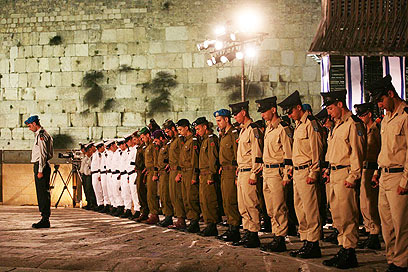
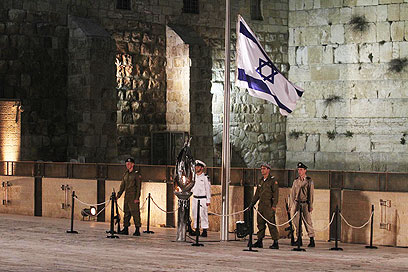
Israelis observed a moment of silence on Sunday in memory of 22,867 fallen soldiers and victims 
of terrorism. President Shimon Peres, Lieutenant-General Benny Gantz and representatives of the bereaved
 families attended a Remembrance Day ceremony at the Western Wall in Jerusalem.

Remember the fallen (Photo: Gil Yohanan)
 
"Israel today is stronger than ever," Peres said. He opened his speech by addressing the Six Day War.
He stressed that Israel will not waive the chance to secure real peace adding that "should one opportunity fail, we shall seek another one."
 
"An Arab voice is being heard in our region calling for liberation and democracy and we wish them success."
 
The president further added: "One day hostility will end and we shall live as neighbors. One day we shall know that they (the fallen) not only defended our lives but were the ones who paved the way to peace. They are both heroes of war and bearers of peace. We cherish the IDF, our beloved army with its soldiers, and fallen (men and women).

Memorial Day ceremony at Western Wall (Photo: Gil Yohanan)
  
"We shall not rest until all our captive and missing soldiers will return home. We shall not rest until we see Gilad Shalit safe and sound here with us."
 

'Highest moral standards'

IDF chief Gantz discussed the repeated attempts to besmirch Israeli soldiers' morals. "We have proven to the world in dozens of operations that our soldiers and commanders hold dear the values of purity of arms and the highest moral standards. These operational and moral norms were set by commanders and soldiers who decided to make persistence the primary value and devoted themselves to upholding the norms."
 
A
Gantz also addressed unrest in the Middle East. "The events which erupted out of repression and desperation raise signs of hope but also undermine stability and add possible threats to the State of Israel. The IDF must therefore be ready to address a growing variety of challenges in every front and possibly all fronts."
 
He mentioned warriors who showed exemplary courage and fortitude. "Such were Golani soldiers who boldly stormed the Beaufort in the 1982 Lebanon War."


http://www.ynetnews.com/articles/0,7340,L-4066336,00.html

Monday, May 2, 2011

May 23: A Balanced Presentation about the Arab-Israeli Conflict

The Troublesome History of the Arab-Israeli Conflict:
                            A Balanced Presentation
                                 

 With  Dr. Arthur Pitz, professor and historian                                      

                              Blackhawk College, St Ambrose University, Augustana College in the Quad Cities

                                                       Monday, May 23, 2011    

                                                                             6:30 pm8:00 pm  

                                  at the Des Moines Public Library, Central Branch, 1000 Grand Avenue, Des Moines


Dr. Pitz will provide a balanced presentation of the Arab-Israeli Conflict.  He has traveled many times to Israel and the Palestinian territories.  In 2010 he spent a month in the region where he was briefed by Israel's Foreign Ministry, traveled to the Israeli towns adjacent to Gaza, and visited the West Bank and a Palestinian refugee camp.


The program is free of charge and open to the public    No reservations required. 


 Sponsored by the Jewish Community Relations Commission of the Jewish Federation of Greater Des Moines and the JFed Forum.    For additional information, contact jcrc@dmjfed.org


Wednesday, April 27, 2011

Sounds like Karthoum in 1967: no, no, no. i.e, No to peace

"Our plan [involving both the Palestinian Authority and Hamas ] does not involve negotiations with Israel or recognizing it," Zahar said. "It will be impossible for an interim government to take part in the peace process with Israel."
more by Mahmoud Zahar - 1 hour ago - Jerusalem Post


Hamas: We won't negotiate peace with Israel

Mahmoud al-Zahar says peace with Israel not on new Palestinian government's agenda. Meanwhile, Fatah and Hamas officials outline terms of reconciliation agreement, stress deal is first step on the way to establish independent state, in joint press conference in Cairo
Elior Levy       ynetnews.com  April 27, 2011
Latest Update: 04.28.11, 01:07 / Israel News

The Palestinian factions have reconciled in the hopes of establishing an independent state, they said in a press conference on Wednesday. Fatah Central Committee Member and chief negotiator Azzam al-Ahmed said, "The agreement is the beginning and we shall take quick steps to end the occupation and establish an independent Palestinian state."
Deal's Outline
Fatah-Hamas pact to include release of prisoners / Elior Levy
PA official says reconciliation agreement stipulates interim government to be composed of 'non-partisan experts.' Senior Hamas member: Pact to include restructuring of PLO, to allow integration of factions
Full story

Al-Ahmed said that the Palestinian people have waited for the agreement for many years, adding that the prays
of Palestinian youth have been answered.

He accused Israel of using the division to "shirk its international responsibilities" and added that the US also abandoned its responsibility for ending "the longest occupation in history."

"We as Palestinians have learned a hard lesson for the past three years in our struggle against the occupation. The occupation exploited the division to judaise Jerusalem, complete the fence and seize lands in the West Bank," al-Ahmed said. "We felt a need to end the division to end the occupation."

The Fatah official stated that Israel had warned Palestinian President Mahmoud Abbas of the consequences of such an agreement. "When Abu Mazen (Abbas) presented his initiative, Netanyahu warned him, but Abu Mazen answered him from Moscow – Hamas comes first. Hamas is part of Palestinian life – it is the forefront of the struggle. Our unity is our best weapon against the occupation."

Hamas' deputy politburo chief Moussa Abu Marzouk announced during the press conference of the coming of a "new age" and said that all Palestinian factions will meet over the weekend to sign the agreement.

"This is not the end of the dialogue," he said. "After all the factions sign the understandings with Fatah and Hamas we shall form a new government and embark on a new era in the Palestinian struggle – in order to obtain our rights and preserve the Palestinian people's national rights."  

'Peace with Israel not on our agenda'

Mahmoud al-Zahar, a senior Hamas leader who participated in the talks said that peace with Israel was not on the table. "Our program does not include negotiations with Israel or recognizing it," Zahhar said in Cairo. "It will not be possible for the interim national government to participate or bet on or work on the peace process with Israel."

Palestinian Prime Minister Salam Fayyad welcomed the agreement in a message posted on his Facebook page. Fayyad said that the deal is a vital step towards unity and would lead to the establishment of an independent Palestinian state on 1967 borders with Jerusalem as capital.

Turkish Foreign Minister Ahmet Davutoglu congratulated Abbas on reaching the agreement.

Hamas Prime Minister Ismail Haniyeh received similar messages from Egypt's Muslim Brotherhood leader Mohammed Badia. Khalil Assaf, independent Palestinian figures assembly representative in the West Bank, said the agreement was "the most important thing to happen to the Palestinians in 2011."

Earlier on Wednesday, Hamas official Mahmoud al-Zahar revealed additional details of the historic pact, including the release of political prisoners and the establishment of a joint security higher committee.

Following the announcement on the unity pact, Palestinians residents across the West Bank and Gaza Strip went out on the streets to celebrate the dramatic reconciliation between the longtime foes.

"It is a positive step for our national unity," said Gaza resident Yusuf Lafy, adding, "It brings us one step closer to liberating our occupied territories, because it will garner international legitimacy."

Cool response from Washington

The United States reacted coolly on Wednesday to the reconciliation annoucement, calling Hamas a "terrorist" group and saying any Palestinian government must renounce violence.

"The United States supports Palestinian reconciliation on terms which promote the cause of peace. Hamas, however, is a terrorist organization which targets civilians," White House spokesman Tommy Vietor said in a statement.

"To play a constructive role in achieving peace, any Palestinian government must accept the Quartet principles and renounce violence, abide by past agreements, and recognize Israel's right to exist," he said.

Spokespersons for the White House and the State Department said that they were seeking more information about the reported deal between the two groups.

Reuters and Roi Kais contributed to this report

Sunday, April 24, 2011

Israeli researchers find way to reverse aging process

Scientists find key to reversing the aging process

http://www.israel21c.org/201104189006/briefs/scientists-find-key-to-reversing-the-aging-process


Israeli researchers claim they have discovered a way to reverse the aging process by removing B lymphocytes - a kind of white blood cell in vertebrate immune systems - from old mice and forcing the production of young cells to replace them. Our immune systems get weaker with age, which explains why elderly people suffer an increase in illnesses, and a decrease in their ability to respond to vaccination. The B lymphocytes, which decline dramatically as we age, have a major impact on the functioning of the immune system, and are responsible for antibody protection.
Using old mice, the researchers from the Technion-Israel Institute of Technology in Haifa, showed that active removal of the B cells changes the body's cellular homeostasis and generates conditions of chronic deficiency in these cells.
To overcome this, the body reactivates the bone marrow, forcing it to produce B cells at a similar rate to young mice. When they studied this, the researchers found the new B cells replaced the old cells that were removed and led to up to 400% improvement in the ability of the treated mice to respond to vaccinations.
"We have succeeded in showing that it is possible to turn back the aging process," lead researcher, Prof. Doron Melamed of the Technion's Rappaport Faculty of Medicine told The Jerusalem Post.
"This paper shows - for the first time - that physiological aging is a regulated process that can be reversed," Melamed told the Post. "It also presents a novel approach for rejuvenating the immune system and for enhancing the efficacy of vaccination among the elderly population."
The scientists published their findings in the scientific journal, Blood, earlier this year.

Palestinians set fire to Jewish holy site, again, after murder of Jewish worshipper

Avi Abelow: The right to life, the freedom to worship, the guarding of holy places, all
things that modern societies respect and uphold yet are not respected
by the Palestinian Authority. Not only did one of their police officers
kill a Jew this morning for praying at Joseph's tomb, now they put
Joseph's tomb on fire, again! When will the world stand up strong
against this hypocrisy?
http://www.youtube.com/watch?v=Hh-6wVnLdSM
 

Friday, April 22, 2011

Iran Divestment bill signed into law by Gov. Branstad on April 20, 2011

The Iran Divestment bill was signed into law on April 20, 2011 by Gov. Branstad. The law restricts direct investment of state funds in companies that provide power production-related services, mineral extraction activities, oil-related activities or military equipment to the government of Iran.
Iowa is now one of twenty -four states having similar legislation.

Americans are concerned, in general, with the Iranian regime's apparent quest to attain nuclear weapons.
As indicated, below, present nuclear negotiation with Iran continue to end unsatisfactorily, according to the European Union.

Nuclear negotiations with Iran end in failure
January 23, 2011|By Julia Damianova, Los Angeles Times [excerpts]

Led by Catherine Ashton, the European Union's foreign policy chief, the diplomats were trying to revive an offer by the United States, France and Russia for a swap of some of Iran's low-enriched uranium stockpile for fuel for the Iranian reactor that produces isotopes for medical purposes.

Ashton said any expectations that Iran would respond positively to the ideas Western diplomats brought to the table were crushed.
"We had hoped to have a detailed and constructive discussion of those ideas," she told reporters in Istanbul. "But it became clear that the Iranian side was not ready for this unless we agree to preconditions related to enrichment and sanctions.

"Both these preconditions are not the way to proceed," she said.

Before the start of the talks, Western diplomats said that Iran needed to come forward with concrete measures to convince the West that its nuclear program was indeed for peaceful purposes.

In 2009, the U.S. and its allies tried to persuade Iran to ship some of its low-enriched uranium stockpile out of the country in exchange for fuel. The West saw the deal as a confidence-building measure and a way to remove material that, if enriched further, could be used for nuclear weapons.

After initially agreeing, Iran backed away from the offer and has since started to enrich uranium further.

Western diplomats warned before the meeting that if the talks failed, new sanctions could follow.